Since he has come into power, Donald Trump has imposed some questionable policies ranging from limiting immigration to pulling out of the Paris climate change agreement. Another one of these is the protectionist policy which has been implemented on Chinese imports, as well as imports from other countries throughout Europe and the rest of the world particularly focusing on the Aluminium and Steel industry. Protectionism is the policy of implementing tariffs on imports from other countries in order shelter its domestic firms from foreign competition with the hope that it will stimulate economic growth within the home country. Protectionism is frequently frowned upon as it can cause a rise in global trade which can bring to a halt to the economic global growth rate. Many domestic firms have frown upon protectionism because when they are impacted by the tariffs, the consequences can be an increases their costs of production and can increase levels of unemployment leading to lower profits for the firm.
President Trump’s decision to implement protectionist policies has come under worldwide criticism. Trump believes that the current trade deals that the US holds with China are unfair and so he has implemented tariffs on a staggering $267 billion worth of Chinese imports much to the displeasure of China. Trump believes that protectionism will stimulate economic growth and improve the current account position of the US as firms are forced to purchase raw materials from domestic firms instead of importing from China because cheaper prices which were once available from China have become more expensive. China however has vowed to fire back with its own $50 million worth of tariffs. This may bring about a trade war which could cause severe damage to the economic growth prospects of both countries if not resolved, also resulting in increased volatility in the exchange rates of the currencies of both countries however Trump seems adamant on keeping the protectionist policy in place until he believes that the trade agreements between the two countries is fair.
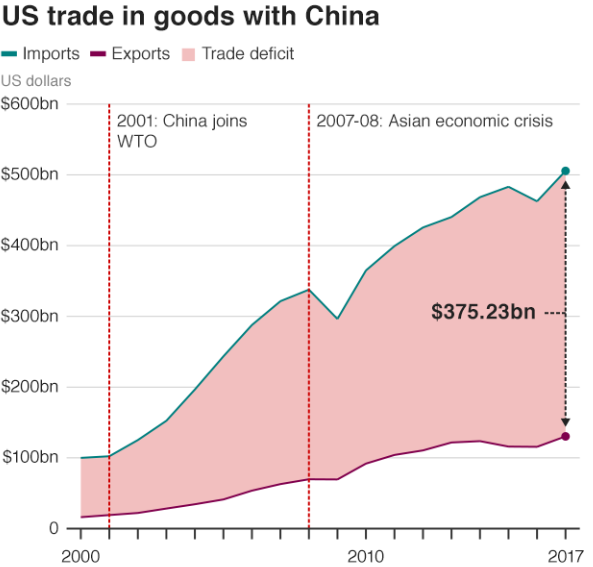
The balance of payments of the US is the record of the international transactions between residents in the US and residents of the rest of the world. The US currently stands at a deficit of $-124.8 billion as of March 2019. One of the key reasons for this high level of deficit currently held by the US is certainly due to the trade deficit it has with China. Would removing this deficit put them in a current account surplus? No, however it would certainly contribute towards doing so. The deficit the US has with China can be illustrated by figure 1 below, showing a staggering US trade deficit of $375.23 billion with the value of imports from China massively outweighing the value of exports the US sends to China. Trump believed something needed to be done about the current account position of the US in particularly the trade deficit it holds with China and so his protectionist policies went ahead.
Volatility of the US dollar was feared after it was announced that the tariffs would be applied. Was it reasonable to have doubts against the policies Trump implemented? Did the policies have negative effects like many economists forecast? Certainly with regards to the exchange rate these fears have been realised. When Trump recently announced that further duties of 23% on Steel and 10% on aluminium would be applied, the dollar depreciated against most currencies around the world for example hitting a low point against the Japanese Yen for two years. It is commonly known, when a currency operates on a floating exchange rate basis like the US dollar does, it is determined by demand and supply for the currency on the foreign exchange market compared to that of other currencies making it more vulnerable to drastic fluctuations. The fall in the US dollar can be due to the growing economic uncertainty which has arisen due to these protectionist policies, it has deterred investors from investing in the dollar and causing the witnessed depreciation.
However what about the Chinese Yuan? What impact has Trump’s protectionism had on China’s exchange rate for the domestic currency the Yuan (commonly known as the Renminbi)?
China’s exchange rate used to operate through a fixed exchange rate and was pegged at a fixed rate against the dollar. It was previously said that the Chinese exchange rate was undervalued by as much as 37.5% against its purchasing power parity (comparing currencies through a basket of goods). The Chinese government in 2006 eventually h decided to change their exchange rate system by allowing the exchange rate to float in a narrow margin around a fixed base rate which was determined by a basket of world currencies determined by demand and supply for the currency, this was used to minimise the risk of drastic currency fluctuations instead of the normal floating exchange rate which could leave the currency more exposed.
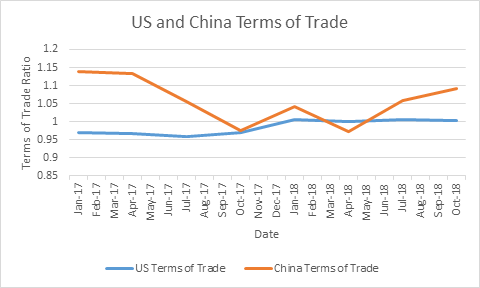
The ongoing trade wars have worsened China’s current account position as it is expected they will eventually become more of an importer than an exporter thanks to Trump’s protectionism policies. When Trump announced his intentions to impose numerous trade tariffs throughout 2018 the Yuan tumbled against the US dollar significantly. Can a depreciation in the Chinese exchange rate be a positive for China? Not with regards to their terms of trade ratio that’s for sure. With a depreciation in the Yuan caused by Trumps protectionism, we would expect to see a deterioration in the terms of trade ratio for China because of the relationship between the exchange rate and relative import and export prices. This is exactly what was illustrated in figure 2 where we can see a drastic increase in China’s terms of trade ratio compared to the US which remains relatively consistent. This deterioration in the terms of trade means that the Chinese now need to export more goods to finance their imports worsening their current account position and trade balance.
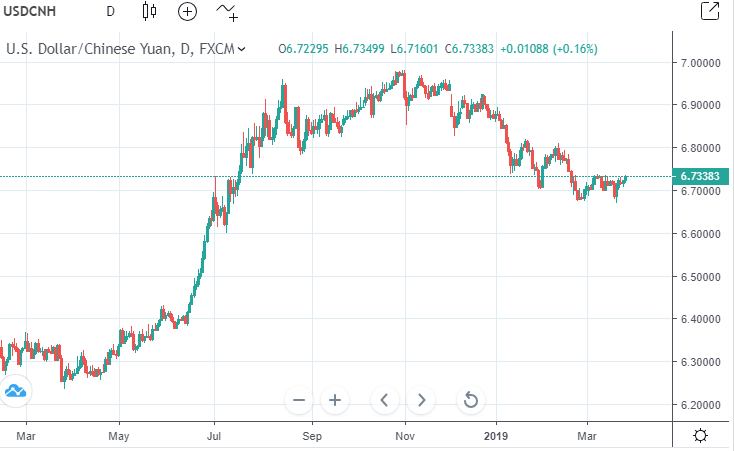
According to the monetary model this may not be as bad for China as it seems, with the increased price of foreign goods in this case US goods, investors see an arbitrage opportunity to buy the Yuan at a cheaper price now and so demand for the Yuan will increase, this then causes the Yuan to eventually appreciate due to the high demand and eventually this leads to an improvement in the Chinese current account. Figure 3 below illustrates this point, as we see the Yuan depreciates during 2018 when Trump announced the protectionist policies he was going to implement. Investors then seize the opportunity to purchase the Yuan for cheaper and eventually we will see the Yuan start to appreciate against the dollar as figure 3 illustrates.
The decision to implement protectionist policies has certainly damaged the future prospects of the Chinese current account and has increased the volatility of both the US dollar and the Chinese Yuan. The trade wars that arise from these protectionist policies can cause major damage to the potential economic growth to both countries as well as on a global level. It remains to be seen whether Trump or China will continue to implement further protectionist policies on one another but one thing is for sure, it will only cause further damage to their economies.
 Alexander Thomas Economics Blog